Search This Blog

Saturday, January 30, 2010

HISTORY OF PAKISTAN


Pakistan traces its history back to 2,500 years B.C., when a highly developed civilization flourished in the Indus Valley. Excavations at Harrappa, Moenjodaro, Kot Diji and Mehr Garh have brought to light, the evidence of an advanced civilization existing even in more ancient times. Around 1,500 B.C., the Aryans overwhelmed this region and influenced the Hindu civilization, whose centre moved to Ganges valley, further east. Later, the Persians occupied the northern region in the 5th century B.C. up to the 2nd century AD. The Greeks came in 327 B.C., under Alexander of Macedonia, and passed away like a meteor. In 712 AD, the Arabs, led by Muhammad Bin Qasim, landed somewhere near modern Karachi and ruled the lower half of Pakistan for 200 years. During this time, Islam took roots in the soil and influenced the life, culture and traditions of the people.

In the 10th century AD, began the systematic conquest of South Asia by the Muslims from Central Asia, who ruled here up to the 18th century. Then the British came and ruled for nearly 100 years over what is Pakistan now.

Zia Regime


When the situation seemed to be deadlocked, the army Chief of Staff, General Muhammad Zia Ul-Haq, staged a coup on July 5, 1977, and imposed another military regime. Bhutto was tried for political murder and found guilty; he was hanged on April 4, 1979.
Zia formally assumed the presidency in 1978 and established Shari'ah (Islamic law) as the law of the land. The constitution of 1973 was initially amended, then suspended in 1979, and benches were constituted at the courts to exercise Islamic judicial review.Interest-free banking was initiated, and
Zia-ul-Haq maximum penalties were provided for adultery, defamation, theft, and the consumption of alcohol. On March 24, 1981, Zia issued a provisional constitutional order, operative until the lifting of martial law. It envisaged the appointment of two vice-presidents and allowed political parties that had been approved by the election commission before September 30, 1979, to function. All other parties, including the PPP, now led by Bhutto's widow and by his daughter, Benazir, were dissolved. Pakistan was greatly affected by the Soviet intervention in Afghanistan in December 1979; by 1984 some 3 million Afghan refugees were living along Pakistan's border with
Afghanistan, supported by the government and by international relief agencies. In September 1981 Zia accepted a six-year economic and military aid package (worth US$3.2 billion) from the United States. After a referendum in December 1984 endorsed Zia's Islamic-law policies and the extension of his presidency until 1990, Zia permitted elections for parliament in February 1985. A civilian Cabinet took office in April, and martial law ended in December. Zia, however, was dissatisfied and, in May 1988, he dissolved the government and ordered new elections. Three months later he was killed in an aeroplane crash, and a caretaker military regime took power.

Bhutto Government

Under Bhutto's leadership a diminished Pakistan began to rearrange its national life. Bhutto nationalized basic industries, insurance companies, domestically owned banks, and schools and colleges. He also instituted modest land reforms that benefited tenants and middle-class farmers. He removed the armed forces from the process of decision-making, but to placate the generals he allocated about 6 per cent of the gross national product to defence. In 1973 the National Assembly adopted the country's fifth constitution. Bhutto became Prime Minister, and Fazal Elahi Chaudhry replaced him as President.
Zulfikar Ali Bhutto Although discontented, the military remained silent for some time. Bhutto's nationalization programme and land reforms further earned him the enmity of the entrepreneurial and capitalist class, while religious leaders saw in his socialism an enemy of Islam. His decisive flaw, however, was his inability to deal constructively with the opposition. His rule grew heavy-handed. In general elections in March 1977 nine opposition parties united in the Pakistan National Alliance (PNA) to run against Bhutto's PPP. Losing in three of the four provinces, the PNA alleged that Bhutto had rigged the vote. It boycotted the provincial elections a few days later and organized demonstrations throughout the country that lasted for six weeks.

Civil War

In an attempt to make his regime more acceptable, Yahya dismissed almost 300 senior civil servants and identified 30 families that were said to control about half of Pakistan's gross national product. To curb their power Yahya in 1970 issued an ordinance against monopolies and restrictive trade practices. He also made commitments to transfer power to civilian authorities, but in the process of making this shift, his intended reforms broke down.
Mujib-ur-Rehman The greatest challenge to Pakistan's unity, however, was presented by East Pakistan, led by Sheikh Mujibur Rahman, leader of the Awami League, who insisted on a federation under which East Pakistan would be virtually independent. He envisaged a federal government that would deal with defence and foreign affairs only; even the currencies would be different, although freely convertible. His programme had great emotional appeal for East Pakistanis. In the election of December 1970 called by Yahya, Sheikh Mujib-as Mujibur Rahman was generally called-won by a landslide in East Pakistan, capturing a clear majority in the National Assembly. The Pakistan People's Party (PPP) formed by Bhutto in 1967 emerged as the largest
party in West Pakistan. Suspecting Sheikh Mujib of secessionist politics, Yahya in March 1971 postponed indefinitely the convening of the National Assembly.Mujib in return accused Yahya of collusion with Bhutto and established a virtually independent government in East Pakistan. Yahya opened negotiations with Mujib in Dhaka in mid-March, but the effort soon failed. Mujib was arrested and brought to West Pakistan to be tried for treason. Meanwhile Pakistan's army went into action against Mujib's civilian followers, who demanded freedom and independence for East Pakistan, or Bangladesh ("Bengali Nation") as it was to be called. There were a great many casualties during the ensuing military operations in East Pakistan, during which the Pakistani army attacked the poorly armed population. India claimed that nearly 10 million Bengali refugees crossed its borders, and stories of West Pakistani atrocities abounded. The Awami League leaders took refuge in Calcutta and established a government-in-exile. India finally intervened on December 3, 1971, and the Pakistani army surrendered 13 days later. On December 20 Yahya relinquished power to Bhutto, and in January 1972 the independent state of Bangladesh came into existence. When the Commonwealth of Nations admitted Bangladesh later that year, Pakistan withdrew from membership, not to return until 1989. However, the Bhutto government gave diplomatic recognition to Bangladesh in 1974.

Ayub Years

Ayub Khan Ayub ruled Pakistan almost absolutely for more than ten years, and his regime made some notable achievements, although it did not eliminate the basic problems of Pakistani society. A land reforms commission appointed by Ayub distributed some 900,000 hectares (2.2 million acres) of land among 150,000 tenants. The reforms, however, did not erase feudal relationships in the countryside; about 6,000 landlords still retained an area three times larger than that given to the 150,000 tenants. During Ayub's regime developmental funds to East Pakistan increased more than threefold. This had a noticeable effect on the economy of the eastern part, but the disparity between the two sectors of Pakistan was not eliminated.
Perhaps the most pervasive of Ayub's changes was his system of Basic Democracies. It created 80,000 basic democrats, or union councillors, who were leaders of rural or urban areas around the country. They constituted the electoral college for presidential elections and for elections to the national and provincial legislatures created under the constitution promulgated by Ayub in 1962. The Basic Democratic System had four tiers of government from the national to the local level. Each tier was assigned certain responsibilities in administering the rural and urban areas, such as maintenance of primary schools, public roads, and bridges.
Ayub also promulgated an Islamic marriage and family laws ordinance in 1961, imposing restrictions on polygamy and divorce, and reinforcing the inheritance rights of women and minors.
For a long time Ayub maintained cordial relations with the United States, stimulating substantial economic and military aid to Pakistan. This relationship, however, deteriorated in 1965, when another war with India over Kashmir broke out. The United States then suspended military and economic aid to both countries, thus denying Pakistan badly needed weapons. The USSR then intervened to mediate the conflict, inviting Ayub and Prime Minister Lal Bahadur Shastri of India to Toshkent. By the terms of the so-called Tashkent Agreement of January 1966, the two countries withdrew their forces to pre-war positions and restored diplomatic, economic, and trade relations. Exchange programmes were initiated, and the flow of capital goods to Pakistan increased greatly.
The Tashkent Agreement and the Kashmir war, however, generated frustration among the people of Pakistan and resentment against President Ayub. Foreign
Shastri of India
Minister Zulfikar Ali Bhutto resigned his position and agitated against Ayub's dictatorship and the "loss" of Kashmir. In March 1969 Ayub resigned. Instead of transferring power to the speaker of the National Assembly, as the constitution dictated, he handed it over to the commander-in-chief of the army, General Agha Muhammad Yahya Khan. Yahya became President and declared martial law.

Pre-Republican Era

The first independent government of Pakistan was headed by Prime Minister Liaquat Ali Khan. Muhammad Ali Jinnah was Governor-General until his death in 1948. From 1947 to 1951 the country functioned under unstable conditions. The government endeavoured to create a new national capital to replace Karachi, organize the bureaucracy and the armed forces, resettle refugees, and contend with provincial politicians who often defied its authority. Failing to offer any programme of economic and social reform, however, it did not capture the popular imagination.
In his foreign policy Liaquat established friendly relations with the United States, when he visited President Harry S. Truman in 1950. Liaquat's United States visit injected bitterness into Pakistan's
Liaquat Ali Khan
relations with the Union of Soviet Socialist Republics (USSR) because Liaquat had previously accepted an invitation from Moscow that never materialized in a visit. The United States gave no substantial aid to Pakistan until threeyears later, but the USSR, Pakistan's close neighbour, had been alienated.
After Liaquat was assassinated in 1951, Khwaja Nazimuddin, an East Pakistani who had been Governor-General since Jinnah's death, became Prime Minister. Unable to prevent the erosion of the Muslim League's popularity in East Pakistan, however, he was forced to yield to another East Pakistani, Muhammad Ali Bogra, in 1953.
Iskander Mirza When the Muslim League was routed in East Pakistani elections in 1954, the Governor-General dissolved the constituent assembly as no longer representative. The new assembly that met in 1955 was no longer dominated by the Muslim League. Muhammad Ali Bogra was then replaced by Chaudhuri Muhammad Ali, a West Pakistani. At the same time, Iskander Mirza became the Governor-General of the country.The new constituent assembly enacted a bill, which became effective in October 1955, integrating the four West Pakistani provinces into one political and administrative unit. The assembly also produced a new constitution, which was adopted on March 2, 1956. It declared Pakistan an Islamic republic. Mirza was elected Provisional President

Problems of Partition

The division of the subcontinent caused tremendous dislocations of populations. Some 6 million Hindus and Sikhs moved from Pakistan into India, and about 8 million Muslims migrated from India to Pakistan.
The demographic shift was accompanied by considerable inter-ethnic violence, including massacres, that reinforced bitterness between the two countries. This bitterness was further intensified by disputes over the accession of the former native states of India to either country. Nearly all of these 562 widely scattered polities had joined either India or Pakistan; the princes of Hyderabad, Junagadh, and Kashmir, however, had chosen to join neither country. On August 15, 1947, these three states became technically independent, but when the Muslim ruler of Junagadh, with its predominantly Hindu population, joined Pakistan a month later, India annexed his territory. Hyderabad's Muslim prince, ruling over a mostly Hindu population, tried to postpone any decision indefinitely, but in September 1948 India also settled that issue by pre-emptive annexation. The Hindu ruler of Jammu and Kashmir, whose subjects were 85 per cent Muslim, decided to join India. Pakistan, however, questioned his right to do so, and a war broke out between India and Pakistan. Although the UN subsequently resolved that a plebiscite be held under UN auspices to determine the future of Kashmir, India continued to occupy about two thirds of the state and refused to hold a plebiscite. This deadlock, which still persists, has intensified suspicion and antagonism between the two countries. Quaid-e-Azam giving speech

Creation of Pakistan

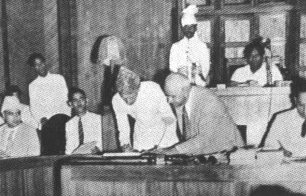
In 1940 the Muslim League formally endorsed the partitioning of British India and the creation of Pakistan as a separate Muslim state. During pre-independence talks in 1946, therefore, the British government found that the stand of the Muslim League on separation and that of the Congress on the territorial unity of India were irreconcilable. The British then decided on partition and on August 15, 1947, transferred power dividedly to India and Pakistan. The latter, however, came into existence in two parts: West Pakistan, as Pakistan stands today, and East Pakistan, now known as Bangladesh. The two were separated by 1,600 km (1,000 mi) of Indian territory. Quaid-e-Azam signing papers

British Rule and Muslim League

The British ruled the Indian subcontinent for nearly 200 years-from 1756 to 1947. After the Indian Mutiny of 1857, the British government abolished the powers of the British East India Company, which had ruled the sub-continent on behalf of the British Crown, and took on direct powers of governance. Political reforms were initiated, allowing the formation of political parties. The Indian National Congress, representing the overwhelming majority of Hindus, was created in 1885. The Muslim League was formed in 1906 to represent and protect the position of the Muslim minority. When the British introduced constitutional reforms in 1909, the Muslims demanded and acquired separate electoral rolls. This guaranteed Muslims representation in the provincia l as well as national legislatures until the dawn of independence in 1947.The idea of a separate Muslim state in south Asia was raised in 1930 by the poet and philosopher Sir Muhammad Iqbal.
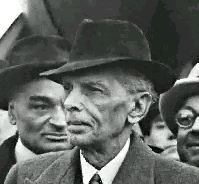
Quaid-e-Azam He suggested that the north-western provinces of British India and the native state of Jammu and Kashmir should be joined into such a state. The name "Pakistan", which came to be used to describe this grouping, is thought to have originated as a compound abbreviation made up of letters of the names of the provinces involved, as follows: Punjab, Afghania (North West Frontier Province), Kashmir, Indus-Sindh, and Balochistan. An alternative explanation says the name means "Land of the Pure". By the end of the 1930s, Muhammad Ali Jinnah, leader of the Muslim League and considered the founding father of Pakistan, had also decided that the only way to preserve Indian Muslims from Hindu domination was to establish a separate Muslim state.