Search This Blog

Saturday, January 30, 2010

HISTORY OF PAKISTAN


Pakistan traces its history back to 2,500 years B.C., when a highly developed civilization flourished in the Indus Valley. Excavations at Harrappa, Moenjodaro, Kot Diji and Mehr Garh have brought to light, the evidence of an advanced civilization existing even in more ancient times. Around 1,500 B.C., the Aryans overwhelmed this region and influenced the Hindu civilization, whose centre moved to Ganges valley, further east. Later, the Persians occupied the northern region in the 5th century B.C. up to the 2nd century AD. The Greeks came in 327 B.C., under Alexander of Macedonia, and passed away like a meteor. In 712 AD, the Arabs, led by Muhammad Bin Qasim, landed somewhere near modern Karachi and ruled the lower half of Pakistan for 200 years. During this time, Islam took roots in the soil and influenced the life, culture and traditions of the people.

In the 10th century AD, began the systematic conquest of South Asia by the Muslims from Central Asia, who ruled here up to the 18th century. Then the British came and ruled for nearly 100 years over what is Pakistan now.

Zia Regime


When the situation seemed to be deadlocked, the army Chief of Staff, General Muhammad Zia Ul-Haq, staged a coup on July 5, 1977, and imposed another military regime. Bhutto was tried for political murder and found guilty; he was hanged on April 4, 1979.
Zia formally assumed the presidency in 1978 and established Shari'ah (Islamic law) as the law of the land. The constitution of 1973 was initially amended, then suspended in 1979, and benches were constituted at the courts to exercise Islamic judicial review.Interest-free banking was initiated, and
Zia-ul-Haq maximum penalties were provided for adultery, defamation, theft, and the consumption of alcohol. On March 24, 1981, Zia issued a provisional constitutional order, operative until the lifting of martial law. It envisaged the appointment of two vice-presidents and allowed political parties that had been approved by the election commission before September 30, 1979, to function. All other parties, including the PPP, now led by Bhutto's widow and by his daughter, Benazir, were dissolved. Pakistan was greatly affected by the Soviet intervention in Afghanistan in December 1979; by 1984 some 3 million Afghan refugees were living along Pakistan's border with
Afghanistan, supported by the government and by international relief agencies. In September 1981 Zia accepted a six-year economic and military aid package (worth US$3.2 billion) from the United States. After a referendum in December 1984 endorsed Zia's Islamic-law policies and the extension of his presidency until 1990, Zia permitted elections for parliament in February 1985. A civilian Cabinet took office in April, and martial law ended in December. Zia, however, was dissatisfied and, in May 1988, he dissolved the government and ordered new elections. Three months later he was killed in an aeroplane crash, and a caretaker military regime took power.

Bhutto Government

Under Bhutto's leadership a diminished Pakistan began to rearrange its national life. Bhutto nationalized basic industries, insurance companies, domestically owned banks, and schools and colleges. He also instituted modest land reforms that benefited tenants and middle-class farmers. He removed the armed forces from the process of decision-making, but to placate the generals he allocated about 6 per cent of the gross national product to defence. In 1973 the National Assembly adopted the country's fifth constitution. Bhutto became Prime Minister, and Fazal Elahi Chaudhry replaced him as President.
Zulfikar Ali Bhutto Although discontented, the military remained silent for some time. Bhutto's nationalization programme and land reforms further earned him the enmity of the entrepreneurial and capitalist class, while religious leaders saw in his socialism an enemy of Islam. His decisive flaw, however, was his inability to deal constructively with the opposition. His rule grew heavy-handed. In general elections in March 1977 nine opposition parties united in the Pakistan National Alliance (PNA) to run against Bhutto's PPP. Losing in three of the four provinces, the PNA alleged that Bhutto had rigged the vote. It boycotted the provincial elections a few days later and organized demonstrations throughout the country that lasted for six weeks.

Civil War

In an attempt to make his regime more acceptable, Yahya dismissed almost 300 senior civil servants and identified 30 families that were said to control about half of Pakistan's gross national product. To curb their power Yahya in 1970 issued an ordinance against monopolies and restrictive trade practices. He also made commitments to transfer power to civilian authorities, but in the process of making this shift, his intended reforms broke down.
Mujib-ur-Rehman The greatest challenge to Pakistan's unity, however, was presented by East Pakistan, led by Sheikh Mujibur Rahman, leader of the Awami League, who insisted on a federation under which East Pakistan would be virtually independent. He envisaged a federal government that would deal with defence and foreign affairs only; even the currencies would be different, although freely convertible. His programme had great emotional appeal for East Pakistanis. In the election of December 1970 called by Yahya, Sheikh Mujib-as Mujibur Rahman was generally called-won by a landslide in East Pakistan, capturing a clear majority in the National Assembly. The Pakistan People's Party (PPP) formed by Bhutto in 1967 emerged as the largest
party in West Pakistan. Suspecting Sheikh Mujib of secessionist politics, Yahya in March 1971 postponed indefinitely the convening of the National Assembly.Mujib in return accused Yahya of collusion with Bhutto and established a virtually independent government in East Pakistan. Yahya opened negotiations with Mujib in Dhaka in mid-March, but the effort soon failed. Mujib was arrested and brought to West Pakistan to be tried for treason. Meanwhile Pakistan's army went into action against Mujib's civilian followers, who demanded freedom and independence for East Pakistan, or Bangladesh ("Bengali Nation") as it was to be called. There were a great many casualties during the ensuing military operations in East Pakistan, during which the Pakistani army attacked the poorly armed population. India claimed that nearly 10 million Bengali refugees crossed its borders, and stories of West Pakistani atrocities abounded. The Awami League leaders took refuge in Calcutta and established a government-in-exile. India finally intervened on December 3, 1971, and the Pakistani army surrendered 13 days later. On December 20 Yahya relinquished power to Bhutto, and in January 1972 the independent state of Bangladesh came into existence. When the Commonwealth of Nations admitted Bangladesh later that year, Pakistan withdrew from membership, not to return until 1989. However, the Bhutto government gave diplomatic recognition to Bangladesh in 1974.

Ayub Years

Ayub Khan Ayub ruled Pakistan almost absolutely for more than ten years, and his regime made some notable achievements, although it did not eliminate the basic problems of Pakistani society. A land reforms commission appointed by Ayub distributed some 900,000 hectares (2.2 million acres) of land among 150,000 tenants. The reforms, however, did not erase feudal relationships in the countryside; about 6,000 landlords still retained an area three times larger than that given to the 150,000 tenants. During Ayub's regime developmental funds to East Pakistan increased more than threefold. This had a noticeable effect on the economy of the eastern part, but the disparity between the two sectors of Pakistan was not eliminated.
Perhaps the most pervasive of Ayub's changes was his system of Basic Democracies. It created 80,000 basic democrats, or union councillors, who were leaders of rural or urban areas around the country. They constituted the electoral college for presidential elections and for elections to the national and provincial legislatures created under the constitution promulgated by Ayub in 1962. The Basic Democratic System had four tiers of government from the national to the local level. Each tier was assigned certain responsibilities in administering the rural and urban areas, such as maintenance of primary schools, public roads, and bridges.
Ayub also promulgated an Islamic marriage and family laws ordinance in 1961, imposing restrictions on polygamy and divorce, and reinforcing the inheritance rights of women and minors.
For a long time Ayub maintained cordial relations with the United States, stimulating substantial economic and military aid to Pakistan. This relationship, however, deteriorated in 1965, when another war with India over Kashmir broke out. The United States then suspended military and economic aid to both countries, thus denying Pakistan badly needed weapons. The USSR then intervened to mediate the conflict, inviting Ayub and Prime Minister Lal Bahadur Shastri of India to Toshkent. By the terms of the so-called Tashkent Agreement of January 1966, the two countries withdrew their forces to pre-war positions and restored diplomatic, economic, and trade relations. Exchange programmes were initiated, and the flow of capital goods to Pakistan increased greatly.
The Tashkent Agreement and the Kashmir war, however, generated frustration among the people of Pakistan and resentment against President Ayub. Foreign
Shastri of India
Minister Zulfikar Ali Bhutto resigned his position and agitated against Ayub's dictatorship and the "loss" of Kashmir. In March 1969 Ayub resigned. Instead of transferring power to the speaker of the National Assembly, as the constitution dictated, he handed it over to the commander-in-chief of the army, General Agha Muhammad Yahya Khan. Yahya became President and declared martial law.

Pre-Republican Era

The first independent government of Pakistan was headed by Prime Minister Liaquat Ali Khan. Muhammad Ali Jinnah was Governor-General until his death in 1948. From 1947 to 1951 the country functioned under unstable conditions. The government endeavoured to create a new national capital to replace Karachi, organize the bureaucracy and the armed forces, resettle refugees, and contend with provincial politicians who often defied its authority. Failing to offer any programme of economic and social reform, however, it did not capture the popular imagination.
In his foreign policy Liaquat established friendly relations with the United States, when he visited President Harry S. Truman in 1950. Liaquat's United States visit injected bitterness into Pakistan's
Liaquat Ali Khan
relations with the Union of Soviet Socialist Republics (USSR) because Liaquat had previously accepted an invitation from Moscow that never materialized in a visit. The United States gave no substantial aid to Pakistan until threeyears later, but the USSR, Pakistan's close neighbour, had been alienated.
After Liaquat was assassinated in 1951, Khwaja Nazimuddin, an East Pakistani who had been Governor-General since Jinnah's death, became Prime Minister. Unable to prevent the erosion of the Muslim League's popularity in East Pakistan, however, he was forced to yield to another East Pakistani, Muhammad Ali Bogra, in 1953.
Iskander Mirza When the Muslim League was routed in East Pakistani elections in 1954, the Governor-General dissolved the constituent assembly as no longer representative. The new assembly that met in 1955 was no longer dominated by the Muslim League. Muhammad Ali Bogra was then replaced by Chaudhuri Muhammad Ali, a West Pakistani. At the same time, Iskander Mirza became the Governor-General of the country.The new constituent assembly enacted a bill, which became effective in October 1955, integrating the four West Pakistani provinces into one political and administrative unit. The assembly also produced a new constitution, which was adopted on March 2, 1956. It declared Pakistan an Islamic republic. Mirza was elected Provisional President

Problems of Partition

The division of the subcontinent caused tremendous dislocations of populations. Some 6 million Hindus and Sikhs moved from Pakistan into India, and about 8 million Muslims migrated from India to Pakistan.
The demographic shift was accompanied by considerable inter-ethnic violence, including massacres, that reinforced bitterness between the two countries. This bitterness was further intensified by disputes over the accession of the former native states of India to either country. Nearly all of these 562 widely scattered polities had joined either India or Pakistan; the princes of Hyderabad, Junagadh, and Kashmir, however, had chosen to join neither country. On August 15, 1947, these three states became technically independent, but when the Muslim ruler of Junagadh, with its predominantly Hindu population, joined Pakistan a month later, India annexed his territory. Hyderabad's Muslim prince, ruling over a mostly Hindu population, tried to postpone any decision indefinitely, but in September 1948 India also settled that issue by pre-emptive annexation. The Hindu ruler of Jammu and Kashmir, whose subjects were 85 per cent Muslim, decided to join India. Pakistan, however, questioned his right to do so, and a war broke out between India and Pakistan. Although the UN subsequently resolved that a plebiscite be held under UN auspices to determine the future of Kashmir, India continued to occupy about two thirds of the state and refused to hold a plebiscite. This deadlock, which still persists, has intensified suspicion and antagonism between the two countries. Quaid-e-Azam giving speech

Creation of Pakistan

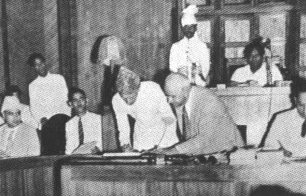
In 1940 the Muslim League formally endorsed the partitioning of British India and the creation of Pakistan as a separate Muslim state. During pre-independence talks in 1946, therefore, the British government found that the stand of the Muslim League on separation and that of the Congress on the territorial unity of India were irreconcilable. The British then decided on partition and on August 15, 1947, transferred power dividedly to India and Pakistan. The latter, however, came into existence in two parts: West Pakistan, as Pakistan stands today, and East Pakistan, now known as Bangladesh. The two were separated by 1,600 km (1,000 mi) of Indian territory. Quaid-e-Azam signing papers

British Rule and Muslim League

The British ruled the Indian subcontinent for nearly 200 years-from 1756 to 1947. After the Indian Mutiny of 1857, the British government abolished the powers of the British East India Company, which had ruled the sub-continent on behalf of the British Crown, and took on direct powers of governance. Political reforms were initiated, allowing the formation of political parties. The Indian National Congress, representing the overwhelming majority of Hindus, was created in 1885. The Muslim League was formed in 1906 to represent and protect the position of the Muslim minority. When the British introduced constitutional reforms in 1909, the Muslims demanded and acquired separate electoral rolls. This guaranteed Muslims representation in the provincia l as well as national legislatures until the dawn of independence in 1947.The idea of a separate Muslim state in south Asia was raised in 1930 by the poet and philosopher Sir Muhammad Iqbal.
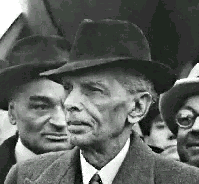
Quaid-e-Azam He suggested that the north-western provinces of British India and the native state of Jammu and Kashmir should be joined into such a state. The name "Pakistan", which came to be used to describe this grouping, is thought to have originated as a compound abbreviation made up of letters of the names of the provinces involved, as follows: Punjab, Afghania (North West Frontier Province), Kashmir, Indus-Sindh, and Balochistan. An alternative explanation says the name means "Land of the Pure". By the end of the 1930s, Muhammad Ali Jinnah, leader of the Muslim League and considered the founding father of Pakistan, had also decided that the only way to preserve Indian Muslims from Hindu domination was to establish a separate Muslim state.

Wednesday, January 27, 2010

Post-1948 developments

Topographic map of Kasmir.

The eastern region of the erstwhile princely state of Kashmir has also been beset with a boundary dispute. In the late 19th- and early 20th centuries, although some boundary agreements were signed between Great Britain, Afghanistan and Russia over the northern borders of Kashmir, China never accepted these agreements, and the official Chinese position did not change with the communist takeover in 1949. By the mid-1950s the Chinese army had entered the north-east portion of Ladakh.[24]

"By 1956–57 they had completed a military road through the Aksai Chin area to provide better communication between Xinjiang and western Tibet. India's belated discovery of this road led to border clashes between the two countries that culminated in the Sino-Indian war of October 1962."[24]

China has occupied Aksai Chin since the early 1950s and, in addition, an adjoining region almost 8% of the territory, the Trans-Karakoram Tract was ceded by Pakistan to China in 1963.

Meanwhile, elections were held in Indian Jammu & Kashmir, which brought up the popular Muslim leader Sheikh Abdullah, who with his party National Conference, by and large supported India. The elected Constituent Assembly met for the first time in Srinagar on October 31, 1951.[25] Then The State Constituent Assembly ratified the accession of the State to the Union of India on February 6, 1954 and the President of India subsequently issued the Constitution (Application to J&K) Order under Article 370 of the Indian Constitution extending the Union Constitution to the State with some exceptions and modifications. The State’s own Constitution came into force on January 26, 1957 under which the elections to the State Legislative Assembly were held for the first time on the basis of adult franchise the same year. This Constitution further reiterated the ratification of the State’s accession to Union of India.[25] However, these tidings were not recognized by Pakistan, which has continued to press for a plebiscite to ascertain the wishes of the people. Pakistan set up its own Kashmir, called Azad Kashmir in a tiny Western chunk that it controls. The much larger region of Pakistani Kashmir in the North-West, which was a province named Northern Areas in the erstwhile state, by and large bore no mention in Pakistani laws and Constitution as being of any status, until in 1982 the Pakistani President General Zia ul Haq proclaimed that the people of the Northern Areas were Pakistanis and had nothing to do with the State of Jammu and Kashmir.[26]


Sikh rule and Princely State

1909 Map of the Princely State of Kashmir and Jammu. The names of regions, important cities, rivers, and mountains are underlined in red.

By the early 19th century, the Kashmir valley had passed from the control of the Durrani Empire of Afghanistan, and four centuries of Muslim rule under the Mughals and the Afghans, to the conquering Sikh armies. Earlier, in 1780, after the death of Ranjit Deo, the Raja of Jammu, the kingdom of Jammu (to the south of the Kashmir valley) was captured by the Sikhs under Ranjit Singh of Lahore and afterwards, until 1846, became a tributary to the Sikh power.[18] Ranjit Deo's grandnephew, Gulab Singh, subsequently sought service at the court of Ranjit Singh, distinguished himself in later campaigns, especially the annexation of the Kashmir valley by the Sikhs army in 1819, and, for his services, was appointed governor of Jammu in 1820. With the help of his officer, Zorawar Singh, Gulab Singh soon captured Ladakh and Baltistan, regions to the east and north-east of Jammu.[18]

In 1845, the First Anglo-Sikh War broke out, and Gulab Singh "contrived to hold himself aloof till the battle of Sobraon (1846), when he appeared as a useful mediator and the trusted advisor of Sir Henry Lawrence. Two treaties were concluded, of which the first gave the State of Lahore (i.e. West Punjab) to the British, whereas the second gave all the hilly or mountainous country situated to the east of Indus and west of Ravi" (i.e. the Vale of Kashmir) to Gulab Singh.[19][18] Soon after Gulab Singh's death in 1857, his son, Ranbir Singh, added the emirates of Hunza, Gilgit and Nagar to the kingdom.

Portrait of Maharaja Gulab Singh in 1847, a year after signing the Treaty of Amritsar, when he became Maharaja by purchasing the territories of Kashmir "to the eastward of the river Indus and westward of the river Ravi"[20] for 75 lakhs rupees from the British (Artist: James Duffield Harding).

The Princely State of Kashmir and Jammu (as it was then called) was constituted between 1820 and 1858 and was "somewhat artificial in composition and it did not develop a fully coherent identity, partly as a result of its disparate origins and partly as a result of the autocratic rule which it experienced on the fringes of Empire."[21] It combined disparate regions, religions, and ethnicities: to the east, Ladakh was ethnically and culturally Tibetan and its inhabitants practised Buddhism; to the south, Jammu had a mixed population of Hindus, Muslims and Sikhs; in the heavily populated central Kashmir valley, the population was overwhelmingly Sunni Muslim, however, there was also a small but influential Hindu minority, the Kashmiri brahmins or pandits; to the northeast, sparsely populated Baltistan had a population ethnically related to Ladakh, but which practised Shi'a Islam; to the north, also sparsely populated, Gilgit Agency, was an area of diverse, mostly Shi'a groups; and, to the west, Punch was Muslim, but of different ethnicity than the Kashmir valley.[21] After the Indian Rebellion of 1857, in which Kashmir sided with the British, and the subsequent assumption of direct rule by Great Britain, the princely state of Kashmir came under the suzerainty of the British Crown.

Muslim rule

Gateway of enclosure, (once a Hindu temple) of Zein-ul-ab-ud-din's Tomb, in Srinagar. Probable date A.D. 400 to 500, 1868. John Burke. Oriental and India Office Collection. British Library.


The Muslims and Hindus of Kashmir lived in relative harmony, since the Sufi-Islamic way of life that Muslims followed in Kashmir complemented the Rishi tradition of Kashmiri Pandits.[citation needed] This led to a syncretic culture where Hindus and Muslims revered the same local saints and prayed at the same shrines[citation needed]. Famous sufi saint Bulbul Shah was able to convert Rinchan Shah who was then prince of Kashgar Ladakh to an Islamic lifestyle, thus founding the Sufiana composite culture. Under this rule, Muslim, Hindu and Buddhist Kashmiris generally co-existed peacefully. Over time, however, the Sufiana governance gave way to outright Muslim monarchs

First Muslim Ruler, Shah Mir

In the beginning of 14th century a ferocious Mongol, Dulucha invaded the valley through its northern side Zojila Pass, with an army of 60,000 men. Like Taimur in the Punjab and Delhi, Dulucha carried sword and fire, destroyed towns and villages and slaughtered thousands. His savage attack practically ended the Hindu rule in Kashmir. A weak and worthless man Raja Sahadev was the ruler then. It was during his reign that three adventurers, Shah Mir from Swat ( Tribal) territory on the borders of Afganistan, Rinchin from Ladhak, and Lankar Chak from Dard territory near Gilgit came to Kashmir, and played a notable role in subsequentive political history of the valley. All the three men were granted Jagirs by the King. Rinchin for 3 years became the ruler of Kashmir, Shah Mir was the first rular of Shah Miri-dynasty. After his demise, his son Jamshed became the ruler who was later removed by his own brother Ali Sher Swati in the matter of just a couple of months.

Some Kashmiri rulers, such as Sultan Zain-ul-Abidin(r.1423-1474), were tolerant of all religions in a manner comparable to Akbar. However, several Muslim rulers of Kashmir were intolerant of other religions. Sultãn Sikandar Butshikan of Kashmir (AD 1389-1413) is often considered the worst of these. Historians have recorded many of his atrocities. The Tarikh-i-Firishta records that Sikandar persecuted the Hindus and issued orders proscribing the residence of any other than Muslims in Kashmir. He also ordered the breaking of all "golden and silver images". The Tarikh-i-Firishta further states: "Many of the Brahmins, rather than abandon their religion or their country, poisoned themselves; some emigrated from their native homes, while a few escaped. After the emigration of the Brahmins, Sikandar ordered all the temples in Kashmir to be thrown down. Having broken all the images in Kashmir, (Sikandar) acquired the title of ‘Destroyer of Idols’."[17]

The metrical chronicle of the kings of Kashmir, called Rajatarangini, has been pronounced by Professor H.H.Wilson to be the only Sanskrit composition yet discovered to which the appellation "history" can with any propriety be applied. It first became known to the Muslims when, on Akbar's invasion of Kashmir in 1588, a copy was presented to the emperor. A translation into Persian was made at his order. A summary of its contents, taken from this Persian translation, is given by Abul Fazl in the Ain-i-Akbari. The Rajatarangini was written by Kalhana about the middle of the 12th century. His work, in six books, makes use of earlier writings that are now lost.

The Rajatarangini is the first of a series of four histories that record the annals of Kashmir. Commencing with a rendition of traditional history of very early times, the Rajatarangini comes down to the reign of Sangrama Deva, (c.1006 AD). The second work, by Jonaraja, continues the history from where Kalhana left off, and, entering the Muslim period, gives an account of the reigns down to that of Zain-ul-ab-ad-din, 1412. P. Srivara carried on the record to the accession of Fah Shah in 1486. The fourth work, called Rajavalipataka, by Prajnia Bhatta, completes the history to the time of the incorporation of Kashmir in the dominions of the Mogul emperor Akbar, 1588.


Buddhism and Hinduism in Kashmir

This general view of the unexcavated Buddhist stupa near Baramulla, with two figures standing on the summit, and another at the base with measuring scales, was taken by John Burke in 1868. The stupa, which was later excavated, dates to 500 CE


The Buddhist Mauryan emperor Ashoka is often credited with having founded the old capital of Kashmir, Shrinagari, now ruins on the outskirts of modern Srinagar. Kashmir was long to be a stronghold of Buddhism.[5]

As a Buddhist seat of learning, it is possible that the Sarvāstivādan school dominated Kashmir.[6] East and Central Asian Buddhist monks are recorded as having visited the kingdom. In the late 4th century AD, the famous Kuchanese monk Kumārajīva, born to an Indian noble family, studied Dīrghāgama and Madhyāgama in Kashmir under Bandhudatta. He later became a prolific translator who helped take Buddhism to China. His mother Jīva is thought to have retired to Kashmir. Vimalākṣa, a Sarvāstivādan Buddhist monk, travelled from Kashmir to Kucha and there instructed Kumārajīva in the Vinayapiṭaka.

Adi Shankara visited the pre-existing Sarvajñapīṭha (Sharada Peeth) in Kashmir in late 8th century CE or early 9th Century CE. The Madhaviya Shankaravijayam states this temple had four doors for scholars from the four cardinal directions. The southern door (representing South India) had never been opened, indicating that no scholar from South India had entered the Sarvajna Pitha. Adi Shankara opened the southern door by defeating in debate all the scholars there in all the various scholastic disciplines such as Mimamsa, Vedanta and other branches of Hindu philosophy; he ascended the throne of Transcendent wisdom of that temple.[7]

Abhinavagupta (approx. 950 - 1020 AD[8][9]) was one of India's greatest philosophers, mystics and aestheticians. He was also considered an important musician, poet, dramatist, exeget, theologian, and logician[10][11] - a polymathic personality who exercised strong influences on Indian culture.[12][13]

He was born in the Valley of Kashmir[14] in a family of scholars and mystics and studied all the schools of philosophy and art of his time under the guidance of as many as fifteen (or more) teachers and gurus.[15] In his long life he completed over 35 works, the largest and most famous of which is Tantrāloka, an encyclopedic treatise on all the philosophical and practical aspects of Trika and Kaula (known today as Kashmir Shaivism). Another one of his very important contributions was in the field of philosophy of aesthetics with his famous Abhinavabhāratī commentary of Nāṭyaśāstra of Bharata Muni.[16]

Etymology

General view of Temple and Enclosure of Marttand (the Sun), at Bhawan, ca. A.D. 490–555; the colonnade ca. A.D. 693–729. Surya Temple at Martand, Jammu & Kashmir, photographed by John Burke, 1868.

The Nilamata Purana describes the Valley’s origin from the waters; Ka (“water”) + Shimir (“to desiccate”), hence, Kaashmir denotes “a land desiccated from water”. An alternate nominal origin theory proposes that Kaashmir is a contraction of either Kashyap-mira or Kashyapmir or Kashyapmeru, denoting the “sea of Kashyapa” and the “mountain of Kashyapa”, eponyms of Kashyapa, the sage credited with having drained the primordial Satisar lake that occupied the Kaashmir valley before he reclaimed it from the water. Considering the Valley an embodiment of the goddess Uma, the Nilamata Purana gives it the place-name Kaashmira, from which derives the contemporary Kashmir place-name. Nonetheless, the Kaashmiris colloquially use the place-name Kashir, which is phonetically derived from Kaashmir, as noted in the Aurel Stein introduction to the Rajatarangini metrical chronicle.

In the Rajatarangini, a history of Kashmir written by Kalhana in the 12th century, it is stated that the valley of Kaashmir was formerly a lake. This was drained by the great rishi or sage, Kashyapa, son of Marichi, son of Brahma, by cutting the gap in the hills at Baramulla (Varaha-mula). Cashmere is a variant spelling of Kaashmir.[4]

Kashmir


Kashmir is the northwestern region of the Indian subcontinent. Until the mid-19th century, the term Kashmir geographically denoted only to the valley between the Great Himalayas and the Pir Panjal mountain range.[citation needed] Contemporarily, Kashmir denotes a larger area that includes the Indian-administered Jammu and Kashmir (the Kashmir valley, Jammu and Ladakh), the Pakistani-administered Northern Areas and the Azad Kashmir provinces, and the Chinese-administered regions of Aksai Chin and Trans-Karakoram Tract. The United Nations,[1] and other local entities, use the designation Jammu and Kashmir to geographically denote the said area.

In the first half of the first millennium, the Kashmir region became an important center of Buddhism and later of Hinduism; later still, in the ninth century, Kashmir Shaivism arose.[2] In 1349, Shah Mir became the first Muslim ruler of Kashmir and inaugurated the Salatin-i-Kashmir or Swati dynasty.[3] For the next five centuries, Muslim monarchs ruled Kashmir, including the Mughals, who ruled from 1526 until 1751, then the Afghan Durrani Empire that ruled from 1747 until 1820.[3] That year, the Sikhs under Ranjit Singh, annexed Kashmir.[3] In 1846, upon the purchase of the region from the British under the Treaty of Amritsar, the Dogras—under Gulab Singh—became the new rulers. Dogra Rule, under the paramountcy (or tutelage) of the British Crown, lasted until 1947, when the former princely state became a disputed territory, now administered by three countries: India, Pakistan, and the People's Republic of China.

Monday, January 25, 2010

Sports

Sports in Pakistan
Cricket is the most popular sport in Pakistan
The national sport of Pakistan is Field hockey, although Cricket is the most popular game across the country. The national cricket team has won the Cricket World Cup once (in 1992), were runners-up once (in 1999), and co-hosted the games twice (in 1987 and 1996). Pakistan were runners-up in the inaugural 2007 ICC World Twenty20 held in South Africa and are the champions of 2009 ICC World Twenty20 held in England. Squash is another sport that Pakistanis have excelled in. Successful world-class squash players such as Jahangir Khan and Jansher Khan won the World Open several times during their careers.
Polo is regarded as a traditional sport and played widely in the northern areas
At an international level, Pakistan has competed many times at the Summer Olympics in field hockey, Boxing, athletics, swimming, and Shooting. Pakistan's medal tally remains at 10 medals (3 gold, 3 silver and 4 bronze) while at the Commonwealth Games and Asian Games it stands at 61 medals and 182 medals respectively. Hockey is the sport in which Pakistan has been most successful at the Olympics, with three gold medals in (1960, 1968, and 1984). Pakistan has also won the Hockey World Cup a record four times (1971, 1978, 1982, 1994). The Motorsport Association of Pakistan is a member of the Fédération Internationale de l'Automobile.[140] in Caving adventure sports Pakistan is member country to UIS (Union of International Speleology)[133] The Freedom Rally is a yearly off-road race which takes place during the Independence celebrations. Pakistan also qualified for the Golf World Cup for the first time in 2009.[141]

Tourism

Tourism in Pakistan
PTDC Motel at Malam Jabba Ski Resort.
Despite having an image problem, hyped particularly in the West, and once alleged as one of the most dangerous countries in the world by the British magazine "The Economist",[130] tourism is still a growing industry in Pakistan because of its diverse cultures, peoples and landscapes.[131] The variety of attractions ranges from the ruins of ancient civilizations such as Mohenjo-daro, Harappa and Taxila, to the Himalayan hill-stations, that attract those interested in field and winter sports. Pakistan also has several mountain peaks of height over 8,000 metres (26,250 ft), that attract adventurers and mountaineers from around the world, especially to K2.[132] Starting in April to September, domestic and international tourists visit these areas helping tourism become a source of income for the local people.

In Balochistan there are many caves for cavers and tourists to visit especially the Juniper Shaft Cave, the Murghagull Gharra cave, Mughall saa cave, and naturally decorated cave. Pakistan is a member country of the Union International de Spéléologie (UIS).[133]

The 1872-built Noor Mahal (Diamond Palace), is one of several palaces in the city of Bahawalpur
The northern parts of Pakistan are home to several historical fortresses, towers and other architecture including the Hunza and Chitral valleys, the latter being home to the Kalash, a small pre-Islamic Animist community.[134] Punjab is also the site of Alexander's battle on the Jhelum River. The historic city of Lahore is considered Pakistan's cultural centre and has many examples of Mughal architecture such as the Badshahi Masjid, Shalimar Gardens, Tomb of Jahangir and the Lahore Fort.[135] The Pakistan Tourism Development Corporation (PTDC) also helps promote tourism in the country.[136] However, tourism is still limited because of the lack of proper infrastructure and the worsening security situation in the country. The recent militancy in Pakistan's scenic sites, including Swat in NWFP province, has dealt a massive blow to the tourism industry, beside this much of the troubles in these tourist destinations are also blamed on the frail travel network, tourism regulatory framework, low prioritization of the tourism industry by the government, low effectiveness of marketing and a constricted tourism perception.[137][138] After these areas were being cleared off the militant groups in late 2009, the government of Pakistan with the financial support from the USAID have started a campaign to reintroduced tourism in Swat valley. Pakistan receives 500,000 tourists annually, and almost half of them heads to northern Pakistan.[139]

Culture

Culture of Pakistan
Cloth market in Karachi
A sitar workshop in Islamabad
View of Food Street in Lahore

Pakistani society is largely Hierarchical, with high regard for traditional Islamic values, although urban families have grown into a Nuclear family system because of the socio-economic constraints imposed by the traditional Joint family system.[119] Recent decades have seen the emergence of a middle class in cities like Karachi, Lahore, Rawalpindi, Hyderabad, Faisalabad, Multan and Peshawar that wish to move in a more centrist direction, as opposed to the northwestern regions bordering Afghanistan that remain highly conservative and dominated by centuries-old regional tribal customs. Increasing Globalization has resulted in ranking 46th on the A.T. Kearney/FP Globalization Index.[120]

The variety of Pakistani music ranges from diverse provincial Folk music and traditional styles such as Qawwali and Ghazal Gayaki to modern forms fusing traditional and western music, such as the synchronisation of Qawwali and western music by the world renowned Nusrat Fateh Ali Khan. In addition Pakistan is home to many famous folk singers such as the late Alam Lohar, who is also well known in Indian Punjab. However, majority of Pakistanis listen to Indian music produced by Bollywood and other Indian film industries. The arrival of Afghan refugees in the western provinces has rekindled Pashto and Persian music and established Peshawar as a hub for Afghan musicians and a distribution centre for Afghan music abroad.[121]

State-owned Pakistan Television Corporation (PTV) and Pakistan Broadcasting Corporation were the dominant media outlets, but there are now numerous private television channels. Various American, European, and Asian television channels and films are available to the majority of the Pakistani population via private Television Networks, cable, and Satellite television. There are also small indigenous film industries based in Lahore and Peshawar (often referred to as Lollywood). And while Bollywood films have been banned from being played in public cinemas since 1965 they have remained popular in popular culture.[122]

The architecture of the areas now constituting Pakistan can be designated to four distinct periods—pre-Islamic, Islamic, colonial and post-colonial. With the beginning of the Indus civilization around the middle of the 3rd millennium[123] B.C., an advanced Urban culture developed for the first time in the region, with large structural facilities, some of which survive to this day.[124] Mohenjo Daro, Harappa and Kot Diji belong to the pre-Islamic era settlements. The rise of Buddhism and the Persian and Greek influence led to the development of the Greco-Buddhist style, starting from the 1st century CE. The high point of this era was reached with the culmination of the Gandhara style. An example of Buddhist architecture is the ruins of the Buddhist monastery Takht-i-Bahi in the northwest province.

The arrival of Islam in today's Pakistan meant a sudden end of Buddhist architecture.[125] However, a smooth transition to predominantly pictureless Islamic architecture occurred. The most important of the few completely discovered buildings of Persian style is the tomb of the Shah Rukn-i-Alam in Multan. During the Mughal era design elements of Islamic-Persian architecture were fused with and often produced playful forms of the Hindustani art. Lahore, occasional residence of Mughal rulers, exhibits a multiplicity of important buildings from the empire, among them the Badshahi mosque, the fortress of Lahore with the famous Alamgiri Gate, the colourful, still strongly Persian seeming Wazir Khan Mosque as well as numerous other mosques and mausoleums. Also the Shahjahan Mosque of Thatta in Sindh originates from the epoch of the Mughals. In the British colonial period, predominantly functional buildings of the Indo-European representative style developed from a mixture of European and Indian-Islamic components. Post-colonial national identity is expressed in modern structures like the Faisal Mosque, the Minar-e-Pakistan and the Mazar-e-Quaid.

A Kalash man dances during the Uchau Festival.
The Literature of Pakistan covers the literatures of languages spread throughout the country, namely Urdu, Sindhi, Punjabi, Pushto, Baluchi as well as English[126] and Persian as well. Prior to the 19th century, the literature mainly consisted of Lyric poetry and religious, mystical and popular materials. During the colonial age the native literary figures, under the influence of the Western literature of realism, took up increasingly different topics and telling forms. Today, short stories enjoy a special popularity.[127]

The national poet of Pakistan, Allama Muhammad Iqbal, suggested the creation of a separate homeland for the Muslims of India. However, Iqbal had also wrote the Tarana-e-Hind which stated the belief of a strong united India. His book The Reconstruction of Religious Thought in Islam is a major work of modern Islamic philosophy. The most well-known representative of the contemporary Urdu literature of Pakistan is Faiz Ahmed Faiz. Sufi poetry Shah Abdul Latif, Bulleh Shah and Khawaja Farid are also very popular in Pakistan.[128] Mirza Kalich Beg has been termed the father of modern Sindhi prose.[129]

Education

Education in Pakistan
Punjab University Old Campus, also known as Allama Iqbal Campus
Education in Pakistan is divided into five levels: primary (grades one through five); middle (grades six through eight); high (grades nine and ten, leading to the Secondary School Certificate); intermediate (grades eleven and twelve, leading to a Higher Secondary School Certificate); and University programmes leading to graduate and advanced degrees.[109]

Pakistan also has a parallel secondary school education system in private schools, which is based upon the curriculum set and administered by the Cambridge International Examinations, in place of government exams. Some students choose to take the O level and A level[110] exams through the British Council.

There are currently 730 technical & vocational institutions in Pakistan.[111] The minimum qualifications to enter male vocational institutions, is the completion of grade 8.

Literacy Rate – Pakistan, Sources:[112][113]
The programmes are generally two to three years in length. The minimum qualifications to enter female vocational institutions, is the completion of grade 5.[114] All academic education institutions are the responsibility of the provincial governments. The federal government mostly assists in curriculum development, accreditation and some financing of research.

English medium education is to be extended, on a phased basis, to all schools across the country.[115] Through various educational reforms, by the year 2015, the ministry of education expects to attain 100% enrolment levels amongst primary school aged children, and a literacy rate of 86% amongst people aged over 10.[116]

Pakistan also has Madrassahs that provide free education and also offer free boarding and lodging to students who come mainly from the poorer strata of society.[117] After criticism over terrorists using them for recruiting purposes, efforts have been made to regulate them.[118]